ByJohn A
How AI Can Help Summarize Long Documents
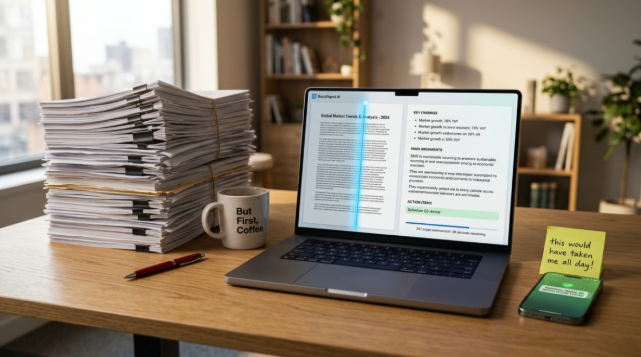
AI can distill lengthy documents into concise, targeted insights. By isolating signal sentences and semantically clustering related ideas, it clarifies core themes. The approach preserves structure—findings, implications, and recommendations—while adjusting tone for different audiences. Transparent processes enable evaluation and reproducibility across domains. The result is faster comprehension and focused navigation, yet the full potential hinges on tool choice and how outputs are integrated into workflows. Further examination promises practical guidance.
How AI Summaries Improve Reading Speed and Focus
AI-generated summaries streamline reading by distilling essential ideas from lengthy texts.
Conciseness accelerates comprehension, enabling readers to grasp core arguments quickly, reducing cognitive load.
Structured extraction highlights relevance, aligning with user intent and efficient decision-making.
Awareness of AI limitations ensures critical evaluation; readers remain vigilant for nuance.
The result is heightened focus, enabling selective engagement and faster judgments without sacrificing essential context or accuracy.
See also: Emerging Trends Shaping the Cryptocurrency Industry
How AI Extracts Key Ideas Across Long Documents
Long documents pose a challenge to identify core ideas efficiently. AI systems perform concise extraction by isolating sentences that signal significance, reducing noise, and preserving meaning.
Semantic clustering groups related concepts across sections, revealing overarching themes and connections. This approach enhances interpretability for readers seeking autonomy, while maintaining structure and transparency in the extraction process.
Choosing the Right AI Tools for Summarization Needs
Choosing the right AI tools for summarization requires aligning capabilities with the document type, desired level of detail, and output format.
Tool selection hinges on task scope, input length, and adaptability.
Evaluation criteria focus on accuracy, coherence, and speed, plus reproducibility across domains.
Audience members seeking freedom should value transparent limits, documented processes, and scalable solutions that match specific summarization goals.
From Abstracts to Executives Summaries: Tailoring Output
From abstracts to executive summaries, output should be tailored to the audience and purpose.
The discussion addresses how AI adapts content flow, tone, and detail level.
Abstract tailoring focuses on essential findings, while executive condensation emphasizes actionable insights.
The approach supports multilevel readers, preserving accuracy and clarity.
Structure remains disciplined: findings, implications, and recommendations, with concise phrasing guiding informed decision making.
Frequently Asked Questions
How Do AI Summaries Handle Nuanced Tone and Rhetoric?
AI summaries preserve some nuance by detecting tone signals and annotating rhetorical cues; however, full tone preservation remains imperfect, as context, sarcasm, and irony challenge algorithms, requiring user judgment and potential post-editing for faithful tone interpretation.
Can AI Summarize Non-Text Formats Like Charts or Tables?
AI chart synthesis can summarize non-text formats by extracting key data patterns; Table interpretation focuses on values, trends, and comparisons. A detached overview notes limitations and encourages human validation for nuanced insights; results empower, not replace, critical judgment.
Do Summaries Protect Sensitive or Confidential Information?
Yes, summaries can protect confidential information when proper privacy safeguards are applied; however, there are potential risks. The discussion highlights privacy safeguards and security implications, emphasizing careful data handling, access controls, and compliance to minimize disclosure while preserving usability.
How Is Bias Mitigated in Ai-Generated Summaries?
Bias mitigation in AI-generated summaries relies on diverse training data, debiasing techniques, and human evaluation; translation issues are monitored, corrected, and documented. It strives for consistency, transparency, and freedom from misleading simplifications, ensuring robust, trustworthy outputs.
What About Summarizing Multilingual or Code-Heavy Documents?
The answer: Multilingual summaries can be produced by multilingual models with careful alignment; code heavy documents require preservation of syntax and semantics. The approach balances accuracy and readability, enabling users to freely extract essential ideas across languages and codebases.
Conclusion
AI-driven summaries act as a lighthouse for lengthy texts, trimming noise while preserving signal. They map sprawling documents into focused clusters, revealing core ideas with clarity. By tailoring outputs—from abstracts to executive briefs—the process guides readers to decisive insights without drowning in detail. Figuratively, ideas braid into a single thread, then form a compass, pointing toward decisions. The result is a compact panorama where every sentence serves purpose, accuracy stays intact, and comprehension accelerates with disciplined, scalable precision.